The problem, with a number
Inlet NOx swinging 70–140 ppm with dust and humidity that defeat narrow-window controls, while BAT-based limits tighten under the revised IED, now national law.

A European cement group needed to know whether regenerative adsorption survives real kiln gas, dust, humidity, load swings. On a ~100 Nm³/h slipstream, after a documented day-1 conditioning phase, NOx uptake stabilised above 85% with outlets near 10 ppm from 70–140 ppm inlets, with SOx co-captured. Service proven: Regenerative NOx Removal.
Client & context
Cement & Lime · Europe · Kiln line flue gas · ~100 Nm³/h slipstream (of >200,000 m³/h stack)
Inlet NOx swinging 70–140 ppm with dust and humidity that defeat narrow-window controls, while BAT-based limits tighten under the revised IED, now national law.
Field analyzers at inlet and outlet (O₂ / CO₂ / NO / NO₂ / SO₂), 5-second-interval time series, bed temperature profiles, chain-of-custody on loaded-media samples for laboratory composition analysis.
Containerised drum adsorber on the slipstream, tailored zeolite media, ~500 W power draw, bottom-up suction, no reagents, no water circuit, installed without touching kiln uptime.
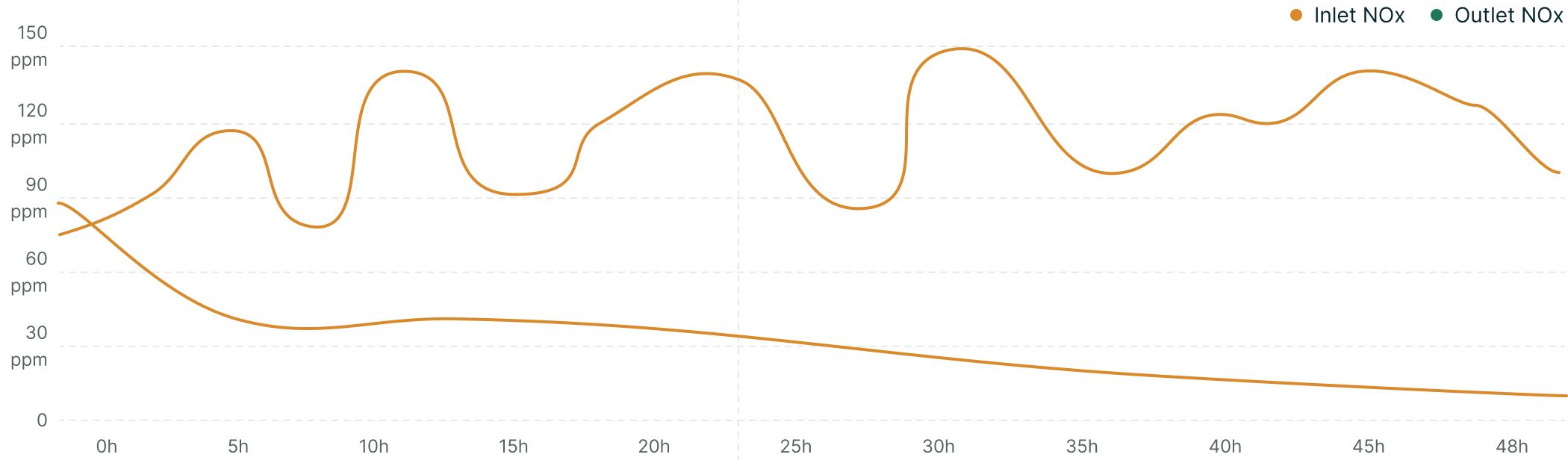
| Metric | Day 1 (conditioning) | Day 2 (stable) |
|---|---|---|
| NOx uptake | ramping, exotherm ~10°C mapped | >85% |
| NOx outlet | variable | ≈10 ppm (inlet 70–140 ppm) |
| SOx | co-captured, documented alongside NOx |
NOx outlet stabilising near 10 ppm on day 2 after conditioning, kiln slipstream at ~100 Nm³/h
We publish the day-1 curve deliberately: the conditioning phase is real physics, and showing it is why operators trust the day-2 number.
WE MEASURED IT.
WE REMOVED IT.
Real kiln gas, real instruments, no marketing haze,
this is what removal looks like when the data is watching.
>85%
NOx uptake, day 2 stable
≈10 ppm
outlet concentration (down from 70–140 ppm inlet)
Zero
reagent, catalyst, or water consumed
A path to compliance margin under the new limits with no ammonia logistics, no catalyst inventory and no water treatment — and conditioning behaviour documented well enough to plan scale-up around it.
Feasibility modelling for extended operation on the line. The ladder in action: analysis → study → pilot.
YOUR GAS IS DIFFERENT.
THAT'S THE POINT.
Start where this case started: one sample, four weeks, €2,900, refunded if no actionable pathway.